
Cape Freels is one of the best and richest shorebird areas in Newfoundland. It’s an ecologically rich ecosystem with extremely high biodiversity (130 species of birds observed) due to its inland and coastal wetlands, variety of habitat types (beaches, sand dunes, coastal marshes, and large eelgrass meadows), its unique location, and its relatively undeveloped state. It’s a staging and wintering area for hundreds of waterfowl of various species and breeding habitat for a variety of shorebirds and other species.
Our goal is to reduce threats to Red Knot, Piping Plover, Rusty Blackbird, and the Short-eared Owl, while restoring their damaged coastal habitat, and educate the public on this important ecosystem. This project builds on related conservation work by adding threat reduction to complement existing land conservation and promotional efforts.
This Community-Nominated Priority Place (CNPP) for Species at Risk project, based in Cape Freels, is undertaken with the financial support of the Government of Canada through the federal Department of Environment and Climate Change.


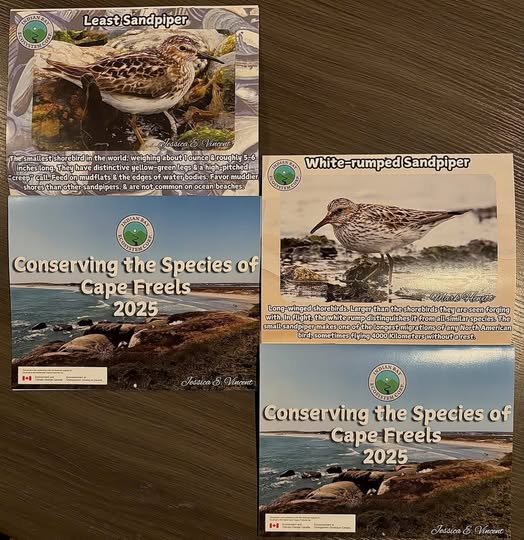
 Our 2025 CNPP Calendars are here!
  (Dec. 12th, 2024)
If you’ve placed an order, they’re ready for pickup during regular office hours. Didn’t order yet? No problem – we’ve got plenty of extras available for anyone who wants one! Comment below if you’d like one!
 Please note: Due to the ongoing Canada Post strike, we are unable to mail calendars at this time. If you need shipping, send us a message and we’ll work out the best solution for you.
This Community-Nominated Priority Place (CNPP) for Species at Risk project, based in Cape Freels, is undertaken with the financial support of the Government of Canada through the federal Department of Environment and Climate Change.
Quick Cleanup Within Our Cape Freels Project Area (July 31st, 2024)
On Monday, some of our staff participated in a quick cleanup of a couple areas around the beaches in our CNPP Cape Freels project area. We got a big help from the Town of New-Wes-Valley staff who picked up garbage that we had placed behind the main garbage bins at the main parking area of the trail system earlier that morning! We had planned to remove it ourselves, but hey, we always like having help when we can get it!
Our crew did pick up washed up nets and old traps that had been buried in the sandbanks for quite some time. Plus, they picked up bits of trash. Jessica continues to pick up trash when she gets the time during her surveys in the area, but we do plan to assist her with another cleanup or two before the end of the Summer.
This Community-Nominated Priority Place (CNPP) for Species at Risk project, based in Cape Freels, is undertaken with the financial support of the Government of Canada through the federal Department of Environment and Climate Change.


Exploring Islands with Hare Bay Adventures (July 30th, 2024)
Today we got to experience one of those “not so usual” type project stuff that we at IBEC tend to get ourselves into nowadays. We were lucky enough to experience several islands off Hare Bay where Eagles, Puffins, various Seagulls, and other birds habit…oh, and of course saw a bunch of whales up close and personal!
Special thank you to Duane and his crew at Hare Bay Adventures for taking us out for a half-day boat ride, specifically allowing us to explore Offer Gooseberry Island where we found Leach’s Storm-Petrel (LESP) burrows and LESP activity! And thank you to the donation from a lady who could not participate in her own boat ride, but decided to give it to a group that she felt would utilize the experience and learn from it. We certainly enjoyed our time on the water and on the island.
If anyone would like to experience a similar half-day adventure with your own group, please give Renee a call at 709-424-3107 for pricing and planning details!


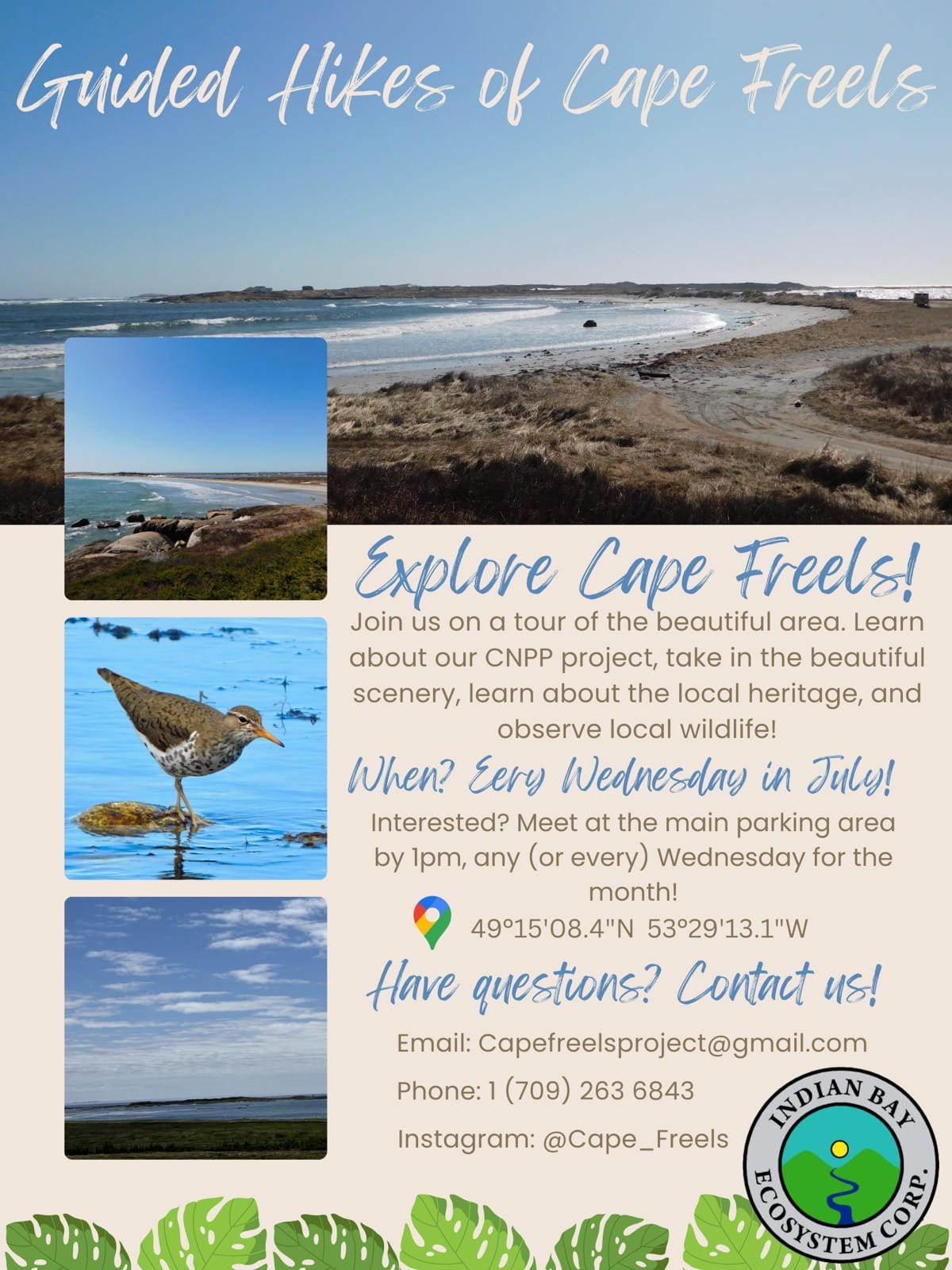
Guided Hiking Tours in July in Cape Freels (June 27th, 2024)
Something new we’ve added to our Community Nominated Priority Place Species at Risk project in Cape Freels this year is a guided hiking tour! Our Project Coordinator Jessica Vincent will lead folks who wish to explore the area, especially along the trail system, and help her look for shorebirds and seabirds!
Starting this coming Wednesday, and following Wednesday’s thereafter in July, she’ll also have our bird guides and information sheets available during each hike. Just show up at the main parking area (coordinates below) at 1pm on Wednesday’s in July!
This Community-Nominated Priority Place (CNPP) for Species at Risk project, based in Cape Freels, is undertaken with the financial support of the Government of Canada through the federal Department of Environment and Climate Change.
Busy week in our CNPP Project area in Cape Freels! (June 20th, 2024)
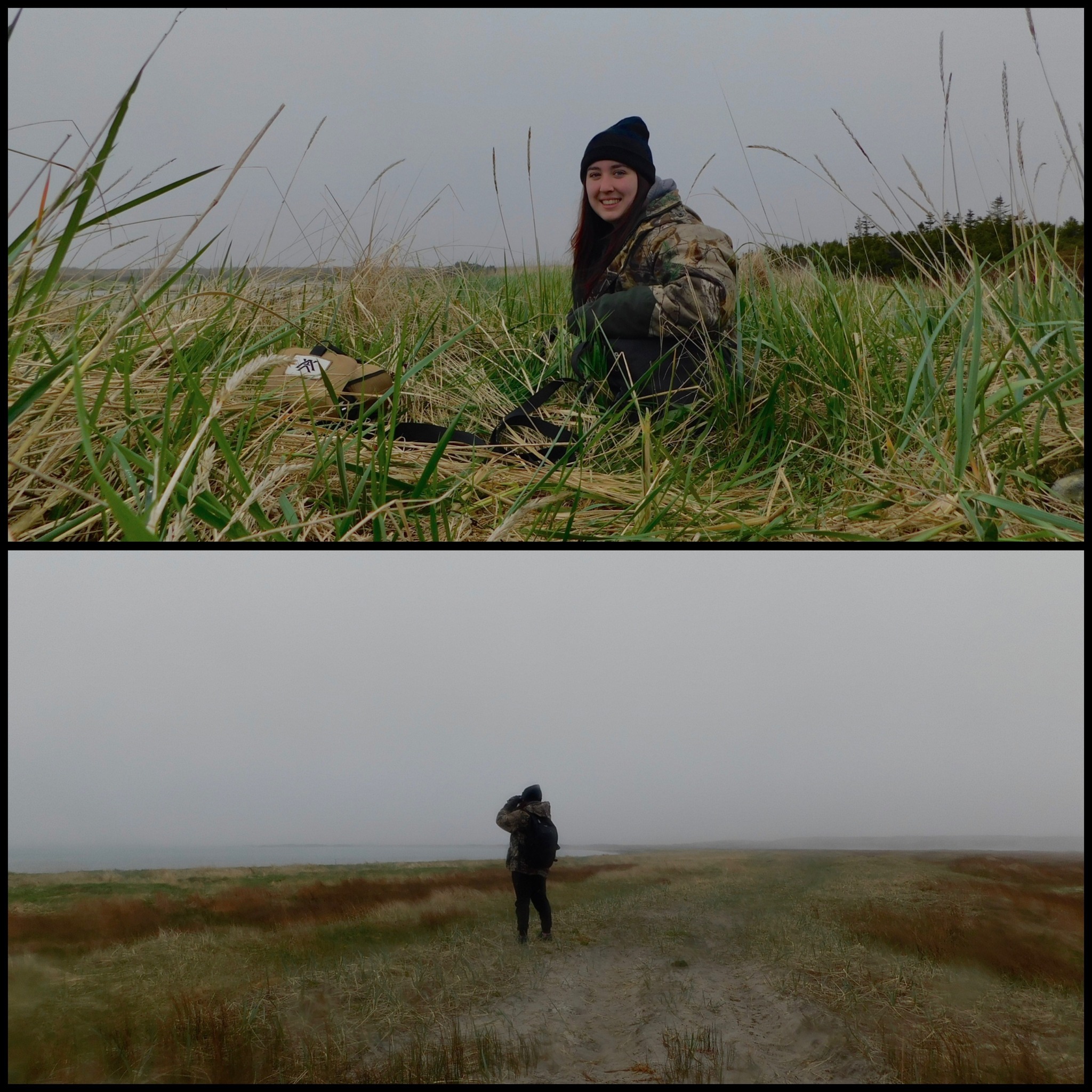
Taking full advantage of the beautiful weather, plus having our Chief Labourer Joe Pickett back for the year, we were able to do our first official cleanup in the area (got a full truckload of various garbage and marine debris). Additional cleanups will occur once our Summer Students start in a couple of weeks!
We have also collected samples for our Leach’s Storm-Petrel (LESP) research, in the way of almost 100 wings from depredated LESP over the past week. These wings will be frozen and analyzed to determine various set of parameters that will help researchers with the Canadian Wildlife Service determine the potential colony which these birds came from, their age, etc.
We also record predator behaviour from coyotes and foxes, which hunt LESP on a regular basis in the area. Our research so far in June has given us some surprises already!
This Community-Nominated Priority Place (CNPP) for Species at Risk project, based in Cape Freels, is undertaken with the financial support of the Government of Canada through the federal Department of Environment and Climate Change.


Cape Freels Drone Footage (June 18th, 2024)
As previously mentioned, IBEC Board member Ian Brackstone did some drone work for us last week in Cape Freels and Queen’s Meade (Newtown). As part of that work, Ian produced a 2-minute video with a tourism flare, that showcases the raw beauty of Cape Freels and the area surrounding it.
This Community-Nominated Priority Place (CNPP) for Species at Risk project, based in Cape Freels, is undertaken with the financial support of the Government of Canada through the federal Department of Environment and Climate Change.
Drone Footage of Cape Freels & Queen’s Meade (June 11th, 2024)
We finally had a lovely morning which allowed us to utilize a drone of our Board member Ian Brackstone, to capture some updated footage of the landscape within our project area. Ian was kind enough to accompany us to Cape Freels and Queen’s Meade (Newtown) and record around 20 minutes of footage, ranging from Southern Bill (our Leach’s Storm-Petrel research area), First Beach, Cape Island Beach, portions of the Wondershore Trail system in Cape Freels, and the bird blind in Queen’s Meade!
The latest footage will be compared to previous video from a few years ago to show the extent of erosion, landscape damage, and related details. Ian will also create a video for us that promotes the area, which we’ll post once completed! We thank Ian for providing us with his drone and video-making skills!
This Community-Nominated Priority Place (CNPP) for Species at Risk project, based in Cape Freels, is undertaken with the financial support of the Government of Canada through the federal Department of Environment and Climate Change.
Student Job Shadowing in Cape Freels (June 6th, 2024)
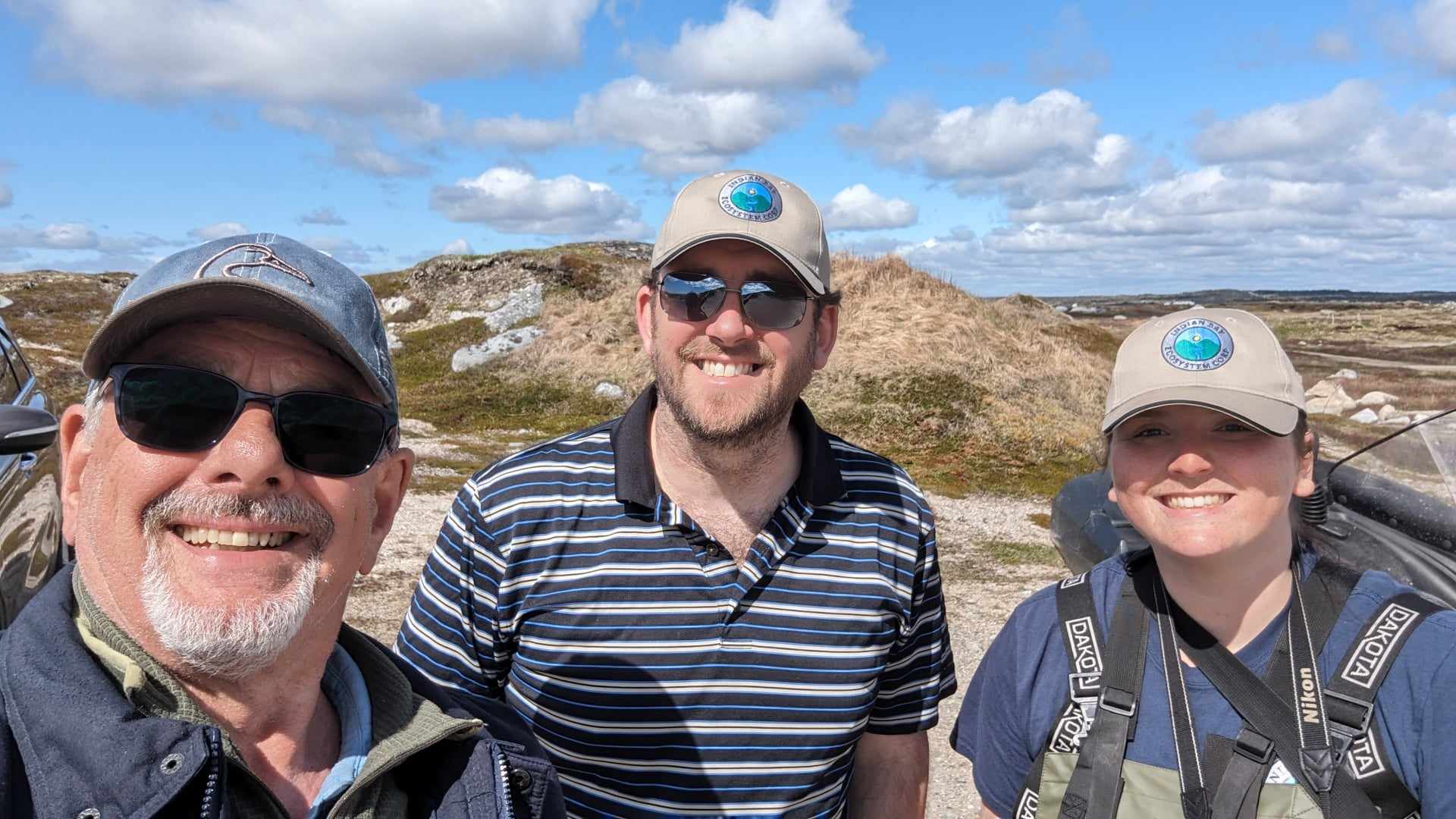
Last Friday, IBEC had the privilege of assisting a young student from central Newfoundland, named Lexie, in completing her on-the-job shadowing experience, for some of her high school credits.
Lexie had expressed interest in our Community-Nominated Priority Place Cape Freels project several months prior. She reached out to us, eager to gain insight into the daily life of a field technician. We were delighted to turn her dream into reality.
Throughout the day, Lexie learned about IBEC’s projects, participated in shorebird and species-at-risk surveys, and mastered the art of identifying species and inputting this vital data. Her enthusiasm and proficiency in the outdoor environment were truly inspiring.
Lexie, your passion for nature and dedication to conservation serves as a beacon for other youth. May they follow your example and contribute to the preservation of our beautiful habitat and its precious species. From all of us at IBEC, we wish you the very best in your future endeavors. May your dreams of working in natural resources continue to flourish!
Guestbook Houses & Information Signage Installed in Cape Freels & Queen’s Meade (May 30th, 2024)
Our information signage regarding shorebirds, some history of Cape Freels, and good stewardship practices are once again back up in Cape Freels at our CNPP Project area! Our Guestbook House is also back for another year of collecting data and thoughts from locals and visitors in the main parking area at the entrance of the Wondershore Trail in Cape Freels.
New this year however, is the addition of another Guestbook House, at the famous bird blind in Queen’s Meade (Newtown)! This one has a survey specific to Newtown and the area surrounding the bird blind, so if you go for a walk out to the blind or are a tourist and wish to see the bird blind, please take a couple minutes to complete a survey! It’s located right next to the bird blind, can’t miss it!
Thanks to our Project Coordinator Jessica Vincent for painting the newest Guestbook House and local woodworker Wayne Bruce for building it (he just used images of the first one he built as reference for the newest one). And thank you to the Town of New-Wes-Valley for allowing us to put the latest Guestbook House on site at the bird blind. We’re hoping for a busy tourist season and local visitors to both locations, with lots of data for our CNPP Project!
This Community-Nominated Priority Place (CNPP) for Species at Risk project, based in Cape Freels, is undertaken with the financial support of the Government of Canada through the federal Department of Environment and Climate Change.


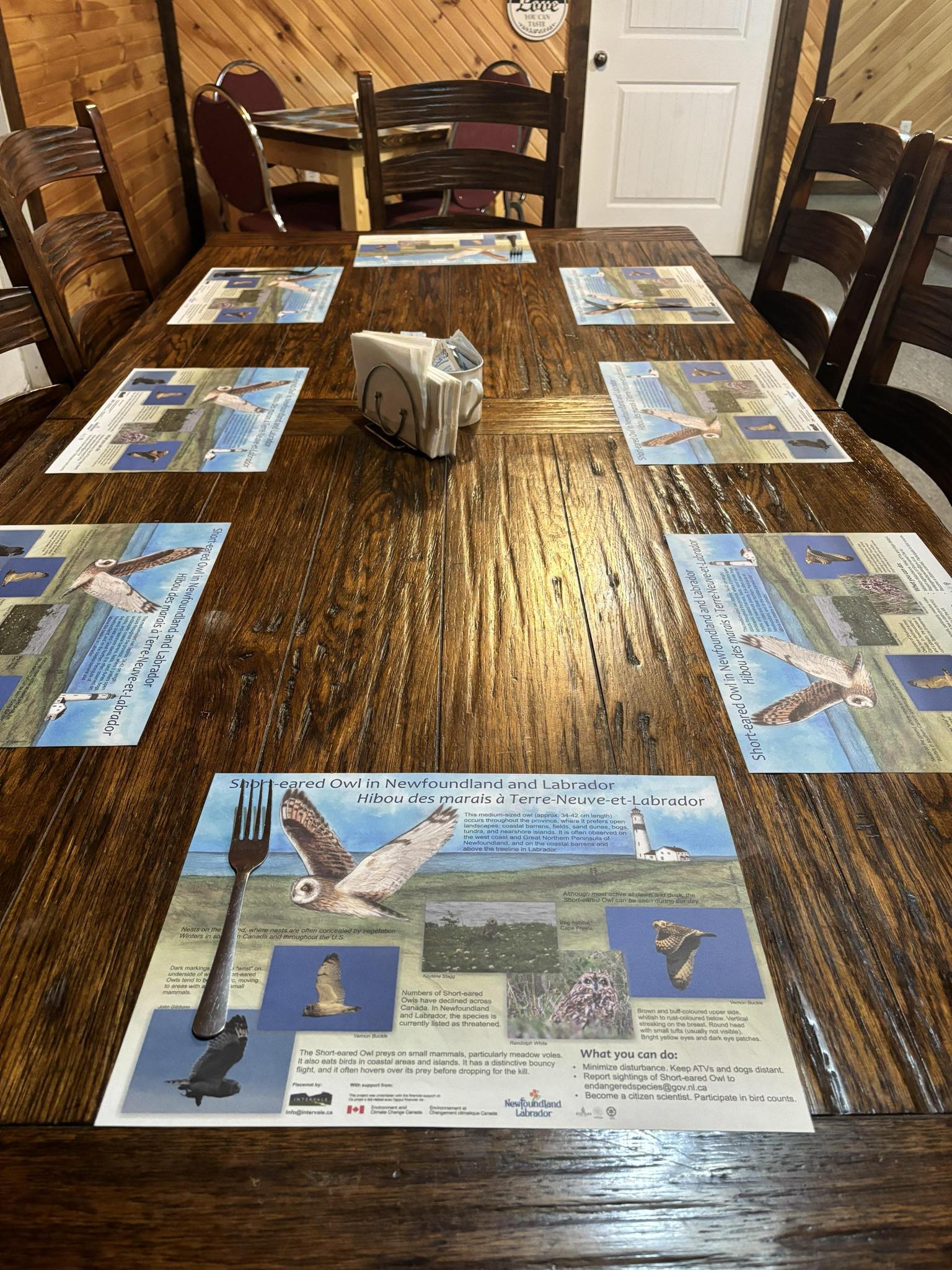
Short-eared Owl Info Placemats Utilized in Local Restaurant (April 17th, 2024)
While enjoying a meal at Amy’s Place, you can now read about Short-eared Owls and their habitat, directly off the placemat! Short-eared Owls are one of our Species at Risk that we conduct research on in Cape Freels, and according to Committee on the status of Endangered Wildlife in Canada (COSEWIC), it is a threatened species in Canada. These placemats will provide information to the reader on habitat these owls live and hunt in, specs on the owl, and where they are located specifically in Newfoundland & Labrador.
We thank Intervale Associates, one of our long-term partners on this Project, for designing and supplying the placemats to us for distribution, and for Amy’s Place for using them on all of their tables!
This Community-Nominated Priority Place (CNPP) for Species at Risk project, based in Cape Freels, is undertaken with the financial support of the Government of Canada through the federal Department of Environment and Climate Change.
Cape Freels in early Winter (January 18th, 2024)
While visiting our Cape Freels Community Nominated Priority Place Project area earlier this week, we noticed quite a bit of erosion along the Cape Island Beach portion. Large portions of beach and sand dunes have been washed away completely by the Atlantic Ocean. Strong storms and high tidal action digs away at the sand along the beach, removing tons of material during this seasonal occurrence. IBEC will monitor this erosion, especially along portions of the sand dunes along the upper portion of the beach.
We also explored prime shorebird watching areas with local birder and IBEC Board member Mark Hewitt. He provided insight into some areas of interest for photography and future project work that we’ll be conducting this coming birding season.
This Community-Nominated Priority Place (CNPP) for Species at Risk project, based in Cape Freels, is undertaken with the financial support of the Government of Canada through the federal Department of Environment and Climate Change.


Promotional Materials Regarding Cape Freels CNPP Project (December 7th, 2023)
As the field season whines down, we’ve been working on some educational materials that promote Cape Freels as a tourist destination, yet provides information on good stewardship practices and the type of shorebirds that visit the area each year.
Our team has produced a 2024 calendar with images of different birds, all taken in Cape Freels. They’ve also worked on four different postcards of scenery and birds from the same area. Very limited calendars were produced due to cost of production, but postcards will be available at local tourist locations this Summer!
We would like to thank Mark Hewitt and Kaylene Stagg for taking the images and designing the layouts for the materials. We’re all very happy with how they turned out! 
This Community-Nominated Priority Place (CNPP) for Species at Risk project, based in Cape Freels, is undertaken with the financial support of the Government of Canada through the federal Department of Environment and Climate Change.


Technology assisting with search for Leach’s Storm-Petrel burrows in Cape Freels (October 26th, 2023)
IBEC utilized a “Gopher Camera” provided to us by our Environment & Climate Change Canada team to search Southern Bill in Cape Freels for Leach’s Storm-Petrel (LESP) burrows. Holes of various depth and length have been located within our Community-Nominated Priority Place project area, with the question of what caused these burrows and tunnels?
So far, research has determined tunnels interconnected allowing for predators (such as foxes) to move freely underneath the ground undetected. LESP may be able to use these spaces as hiding places, however, no signs of nesting regarding LESP can be seen. More research will be conducted to see if other burrows show signs of nesting in the coming days.
This Community-Nominated Priority Place (CNPP) for Species at Risk project, based in Cape Freels, is undertaken with the financial support of the Government of Canada through the federal Department of Environment and Climate Change.


Cape Freels First Beach Cleanup Completed (August 14th, 2023)
The IBEC team completed the first cleanup of the year in Cape Freels a couple weeks back. This cleanup was focused on First Beach, specifically cleaning up debris from beach fires and washed up marine garbage. We removed one pickup truck load of debris from that area. Other cleanups will occur periodically over the next couple of months.
This Community-Nominated Priority Place (CNPP) for Species at Risk project, based in Cape Freels, is undertaken with the financial support of the Government of Canada through the federal Department of Environment and Climate Change.


Signage & Guestbook House back out at Cape Freels (May 19th, 2023)
The fifth year of our Community Nominated Priority Place Species at Risk project in Cape Freels is getting underway. Reinstalled the signage regarding the project and the Guestbook House that has the surveys within in for visitors to fill out regarding their experience in Cape Freels. Over 200 surveys have been completed in the previous two “tourist seasons”, providing excellent feedback to assist us with our research.
We are already assisting the Town of New-Wes-Valley with trail signage and bench placement upon their trail system within the area, and will work with them on other concerns facing the area this coming year.
This Community-Nominated Priority Place for Species at Risk project, based in Cape Freels, is undertaken with the financial support of the Government of Canada through the federal Department of Environment and Climate Change Canada.


February 24th, 2023 – Extension of our Cape Freels Community-Nominated Priority Place Species at Risk Project Approved
Formal approval for the extension of our Conserving & Understanding the Species at Risk of Cape Freels Project has been given. What originally was a two-year project, then expanded to four-years, has now been granted an additional three-year expansion. This allows for IBEC and its partners to continue work in Cape Freels and Queen’s Meade studying Species at Risk through till 2026.
Undertaking collaborative action planning, threat prioritization, and implementation of conservation actions by liaising with local municipalities, leading community outreach, and conducting shorebird monitoring in Cape Freels and Queen’s Meade (Newtown), Newfoundland, has been the main aims to date. Actions will expand with this latest extension in terms of new species targets (e.g. Leach’s Storm Petrel), reach (e.g. new audiences, additional citizens engaged), approaches (e.g. application of complementary communication tools), and evaluation (e.g. analysis of data collected since project start) requiring additional time and resources.
IBEC would like to thank its team with Environment and Climate Change Canada who have worked very hard to ensure this funding was approved and who continue to feel our work along the northeast coast is vital for the conservation efforts of the department and local interest.
September 12th, 2022 – Environmental Presentations at Centreville Academy
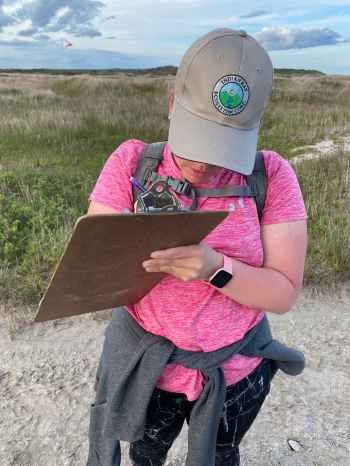
Last week, IBEC and Stewardship Association of Municipalities Inc officials spoke to Grade 2 through 9 at Centreville Academy, about the importance of a healthy ecosystem.
Zachary Burrows, Conservation Biologist with SAM, spoke about the importance of wetlands and salmon habitat, while IBEC’s Executive Director Darren Sheppard and Senior Project Coordinator Kaylene Stagg, spoke about the importance of Cape Freels for shorebirds. Afterwards, a trip outside to explore the area around the school and get some exercise on the beautiful greenspace on the property.
We thank Ms. Perry for coordinating the visit, Zachary for the visit out from St. John’s, and all the staff and students at Centreville Academy for their interest in our presentations!


June 8th, 2022 – World Oceans Day 2022 – IBEC, DFO, and a few new friends
Today, June 8th, is World Oceans Day. We celebrated this with students from Pearson Academy and with officers from the Department of Fisheries and Oceans Enforcement Division (Clarenville, Glovertown, and Bonavista detachments).
We conducted presentations with the Grade 4’s through 6’s at Pearson Academy in the morning, which included sharing information on various ocean-dwelling creatures, and what IBEC does along the northeast coast. We then moved onto Cape Freels, where we conducted a cleanup of the First Beach and main parking areas. This also involved some hot dogs and cake for good measure!
We would like to thank Mrs. Kean, Mrs. Hann, and Mrs. Melindy from Pearson Academy and all of the students for helping us out today. We also would like to thank Officer Gillingham with Glovertown detachment for organizing, and all of the other officers for taking the time out of their busy schedules to assist us at today’s event.


June 2nd, 2022 – Mini-Cleanup in Cape Freels
Completed another successful cleanup of a few areas in Cape Freels earlier this week. With help from some local youth of all ages, we were able to remove debris from around and in the former church basement, along the road leading to the site, and along some portions of the main road in Cape Freels.
This cleanup is partly through our work involving Cape Freels for our shorebird project, seabird study, and also through MMSB’s cleanup program IBEC is involved with this year. We thank those that helped us with this cleanup! Great work!


January 24th, 2022 – Winter in Cape Freels
Below are some images of the wildlife and scenery that you would find in Cape Freels during the winter months. We still check for shorebird activity and other related data that various projects we are involved in would like to have during the colder months. All images are taken by Senior Project Coordinator Kaylene Stagg.


December 14th, 2021 – Guestbook House in Cape Freels a Huge Success!
Our Community-Nominated Priority Place Species at Risk Project in Cape Freels gave IBEC a unique opportunity to collect data about the people who use the area, what they use it for, and if they are using good stewardship practices, via surveys and comments through several books placed in the House. When the House was removed at the beginning of November to prevent damage from happening over the Winter and we tallied up all the surveys that were completed.. we had a whooping 175 surveys filled out!! We had individuals from local communities, almost all provinces, the Northwest Territories and even a few from the United States.
Thank you to all who completed our surveys. This data will help us understand the best way to focus our conservation measures in the years to come.
This Community-Nominated Priority Place for Species at Risk project, based in Cape Freels, is undertaken with the financial support of the Government of Canada through the federal Department of Environment and Climate Change Canada.
September 23rd, 2021 – Stewardship Association of Municipalities Conservation Biologist Visits Cape Freels
IBEC had the opportunity to host Stewardship Association of Municipalities (SAM) Conservation Biologist, Zachary Burrows, as he visited the area for the first time. Zachary met with IBEC officials, who gave him a tour of Queen’s Meade in Newtown and Cape Freels, which are both part of our CNPP project, and our office in Indian Bay. He also met with officials from the Town of New-Wes-Valley, Indian Bay, CWT, and Carmanville, regarding their stewardship plans and to introduce himself.
We thank Zachary and the Stewardship Association of Municipalities for being incredible partners on various projects currently in progress and for their guidance whenever required.

September 8th, 2021 – Pearson Academy Visits Cape Freels
The Grades 5 & 6 of Pearson Academy along with their teachers visited IBEC’s project area in Cape Freels. The students and staff of Pearson Academy learned about our “Conserving and Understanding the Species At Risk of Cape Freels” project, the wildlife that lives there, and how to protect them and the environment they live in. The students also completed a cleanup of the Cape Island Beach area as well.
Special thanks to Pearson Academy for allowing IBEC to teach their students about this project and all the benefits it has to this area!
This Community-Nominated Priority Place for Species at Risk project, based in Cape Freels, is undertaken with the financial support of the Government of Canada through the federal Department of Environment and Climate Change Canada.


August 26th, 2021 – IBEC Team Cleanup of Cape Freels to End the Summer
Students, staff, and volunteers conducted the final Team cleanup of the Summer in the Project site (students finished this week), on First Beach and Cape Island Beach. This cleanup focused on specific areas where beach fires occurred, leaving behind nails, broken glass, and plastics. We also collected general debris along the upper part of Cape Island Beach, close to the sand dunes.
Another pickup truck was filled with debris, disposed of at the local waste management facility. Nails and broken glass have been removed, which will hopefully reduce the risk of injury to those enjoying the sandy beaches, especially children.
We continue to remind the public to ensure all debris is removed after visiting this beautiful area of our province.
This Community-Nominated Priority Place for Species at Risk project, based in Cape Freels, is undertaken with the financial support of the Government of Canada through the federal Department of Environment and Climate Change Canada.


July 28th, 2021 – Cleanup of portions of Cape Freels Hiking Trail
With help from heavy equipment from the Town of New-Wes-Valley, a valued partner of our Cape Freels Shorebird Project, we were able to remove a full dump truck load of trash from the area!
Garbage included a lot of burned items, like tires, mattresses, lots of steal, plastics, glass, and other items. The cabin owners in the area appreciated it, since they were watching us from their decks and said “thank you!” after we finished!
We continue to ask the public not to use the environment, especially those on a Hiking Trail, as your own personal dumping ground (we have waste disposal sites for such things). The number of loads of trash we’ve assisted in taking to the dump continues to rise, and we’ll continue to do our part in making Cape Freels a beautiful spot to visit, and a healthy ecosystem for shorebirds and all wildlife to utilize for breeding, hunting, or stopovers.
This Community-Nominated Priority Place for Species at Risk project, based in Cape Freels, is undertaken with the financial support of the Government of Canada through the federal Department of Environment and Climate Change Canada.


Bird Walk, hosted by Birds Canada, at Cape Freels!
Officials from Birds Canada and IBEC will be on site at Cape Freels, Sunday, June 6th, at 6pm, to conduct a guided Bird Walk through the Cape Freels Hiking Trail area. IBEC is proud to be partnering in this unique experience in our own backyard.
Those interested are asked to meet in the main parking lot to the Trail (please follow our storyboards for directions) where a quick introduction of the group will occur, along with some basic guidelines for the Walk. Please bring your cameras if you’d like to take pictures of the scenery and birds! Dress for the conditions! And don’t forget your binoculars and water!

May 17th, 2021 – Storyboards & Guestbook House Installed at Cape Freels
This Community-Nominated Priority Place for Species at Risk project, based in Cape Freels, is undertaken with the financial support of the Government of Canada through the federal Department of Environment and Climate Change Canada.


January 11th, 2021 – Re-purpose and reuse. Rope turned into artwork.
Rope collected from our cleanups in Cape Freels, and other sources, is being turned into artwork by Duke Kelloway and the team at Norton’s Cove Studio. By IBEC supplying Duke with rope, Norton’s Cove has donated half of the proceeds of sales for these mats to our continuing efforts of cleanup and education regarding our Cape Freels Species At Risk Project, based in Cape Freels.
By buying these mats, you directly help with these cleanups and support local business. If you would like to donate used rope to this cause, feel free to drop it off at the IBEC office during regular business hours.
Thank you to Duke, Janet and the entire Norton’s Cove Studio team for your support!


September 8th, 2020 – Expert Birder On Site
We had some expert assistance with birding down Cape Freels today. Ecosystem Management Ecologist Bruce Rodriques of the Newfoundland and Labrador Department of Wildlife, was on site looking for shorebirds and other species with Project Coordinator Kaylene Stagg. It was a beautiful day birding and they spotted quite a variety of species. Always nice to have our partners assist us with our Species at Risk Project in Cape Freels!
August 18th, 2020 – IBEC is in The Telegram
We were interviewed by The Telegram yesterday regarding our cleanup work in Cape Freels. We spoke about the importance of these cleanups and the overall Project for the area. If you’d like to read the entire article, it is available here!
August 12th, 2020 – Another Cleanup Completed in our Cape Freels Project Area
IBEC employees, students and volunteers completed the second official cleanup within our Project area, this time focusing on the Cape Island Beach portion. We collected another pickup truck full of garbage, ranging from rims, lots of plastics, crab pots, and other junk.
We continue, along with our partners, to collect shorebird and other data within Cape Freels and Queen’s Meade in Newtown. We thank the public for your interest in our Project, for assisting us when possible, and for providing us feedback on the different aspects of our Project.
This Community-Nominated Priority Place for Species at Risk project, based in Cape Freels, is undertaken with the financial support of the Government of Canada through the federal Department of Environment and Climate Change.


July 7th, 2020 – On Tuesday, staff and students of Indian Bay Ecosystem Corporation, Indian Bay Park, and the Town of Indian Bay participated in our first major cleanup of our Species at Risk project area in Cape Freels. We filled two pickup trucks with garbage (old nets, rugs, lots of plastics, etc.) and disposed of it in a proper manner (landfill site). Huge thank you to all who came out to assist us! It was a beautiful day for the cleanup, with everyone enjoying the sunshine! We do have more cleanups scheduled over the next couple of months.
This Community-Nominated Priority Place for Species at Risk project, based in Cape Freels, is undertaken with the financial support of the Government of Canada through the federal Department of Environment and Climate Change.


June 22nd – 27th, 2020 – Conducted a Short-eared Owl survey for the Town of New-Wes-Valley, in association with the provincial Wildlife division, to assist the Town in trail management and development of a trail system in Cape Freels. Images taken are from those evenings doing the survey.
![20200623_212328[1]](https://i0.wp.com/indianbayecosystem.com/wp-content/uploads/2020/06/20200623_2123281.jpg?w=233&h=175&ssl=1 "20200623_212328[1]")
![20200623_205447[1]](https://i0.wp.com/indianbayecosystem.com/wp-content/uploads/2020/06/20200623_2054471.jpg?w=233&h=175&ssl=1 "20200623_205447[1]")
![20200623_194230[1]](https://i0.wp.com/indianbayecosystem.com/wp-content/uploads/2020/06/20200623_1942301.jpg?w=233&h=174&ssl=1 "20200623_194230[1]")
![20200622_200724[1]](https://i0.wp.com/indianbayecosystem.com/wp-content/uploads/2020/06/20200622_2007241.jpg?w=399&h=532&ssl=1 "20200622_200724[1]")
![20200622_201452[1]](https://i0.wp.com/indianbayecosystem.com/wp-content/uploads/2020/06/20200622_2014521.jpg?w=228&h=303&ssl=1 "20200622_201452[1]")
![20200622_200518[1]](https://i0.wp.com/indianbayecosystem.com/wp-content/uploads/2020/06/20200622_2005181.jpg?w=404&h=303&ssl=1 "20200622_200518[1]")
June 2nd, 2020 – Project Coordinator Kaylene Stagg is interviewed by CBC Radio’s “The Broadcast” regarding IBEC’s work in Cape Freels, specifically the cleanups that we have organized and our shorebird data collection. Listen to the full interview here!

May 24th, 2020 – Had a little cleanup down Cape Freels for our Species At Risk project earlier this week. Great job putting a tiny dent in the large amount of garbage in the area. Work was done by our Project Coordinator Kaylene Stagg, with assistance from her boyfriend and father (keeping within her bubble)! We’ll continue such cleanups throughout the year when possible, and hope to have more hands to help as we progress through the year.
This Community-Nominated Priority Place (CNPP) for Species at Risk project, based in Cape Freels, is undertaken with the financial support of the Government of Canada through the federal Department of Environment and Climate Change.


GUESTBOOK HOUSE FOR COMMUNITY-NOMINATED PRIORITY PLACE (CNPP) SPECIES AT RISK – CAPE FREELS PROJECT
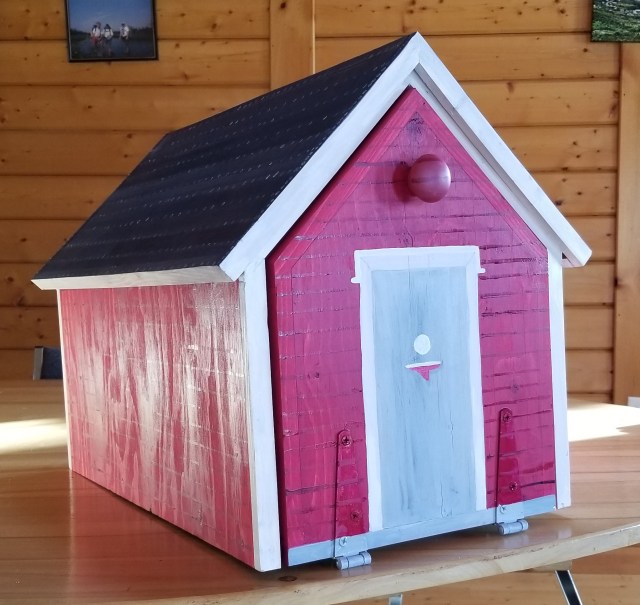
April 10th, 2020 – Locally built and painted, this unique Guestbook House will be placed down Cape Freels later this Spring. The guestbook will allow locals and tourist to assist us with collecting data on several categories we’re seeking (shorebirds seen, type of activity you’re participating in, if you’re visiting, what drew you to Cape Freels, etc.). We plan to use data collected towards our Species at Risk project, especially to get a sense of what those outside the research community feel about the area. Our Project Coordinator, Kaylene Stagg, will collect the book daily and record any data written in it.
Built by Wayne Bruce of Wesleyville (with just the use of a couple images, no drawings or plans whatsoever) and painted by artist Janet Davis of Brookfield (free-hand and not in her normal painting style), this red-stage Guestbook House is something we’re very proud of. We thank Wayne and Janet for assisting us on creating this work of art for our project.
If you’d like to check out more of Janet’s work, please visit her website at https://nortonscove.com/. She’s got some online sales on that might interest you!
The images below show the completed build process and completed painted process.
This Community-Nominated Priority Place (CNPP) for Species at Risk project, based in Cape Freels, is undertaken with the financial support of the Government of Canada through the federal Department of Environment and Climate Change.


QUICK-REFERENCE SHOREBIRD GUIDES FOR CAPE FREELS & QUEEN’S MEADE
March 18th, 2020 – IBEC’s Quick-Reference Shorebird Guide is now available, for free, at our office in Indian Bay!
Funded by the Department of Environment and Climate Change Canada via our Conserving and Understanding the Species at Risk of Cape Freels project, these Guides are great for beginners or avid birdwatchers. Specific to Cape Freels and Queen’s Meade in Newtown, you can easily identify shorebirds you’ll see when within the Project area.
Quick-Reference Guides will also be available later this Spring/Summer at tourism locations along The Shore.


SHOREBIRDS OF CAPE FREELS


QUEEN’S MEADE (NEWTOWN) VIDEO
December 4th, 2019 – Here’s a video of our Community-Nominated Priority Place (CNPP) for Species at Risk Cape Freels Project area. This is Queen’s Meade (pronounced Maid) portion of Newtown, which is just a few kilometres across from our main area in Cape Freels. Its a conservation area protected by the Town of New-Wes-Valley under the Municipal Habitat Stewardship Agreement. Shorebirds are very active in this area, plus it is the location of the newly built bird blind, which we plan to use for photography and research (built for the public to use for those purposes).
We’d like to thank Wayne Lorenzen for the great video work and the usage of his drone.
 Indian Bay Ecosystem Corporation (IBEC)